LUMA-6CH / Development evidence
LUMA-6CH development testing and hardware evolution.
How we prepare and verify this contentThese results describe the units and configurations used during LUMA-6CH development. They document what we tested; they do not replace the specifications, certification or limits of the future commercial version.
Why publish development results?
Headline ratings state what a product should support. Development tests help reveal how electronics, firmware and thermal management behave when loads are sustained or temporarily exceed the rating. Limits matter too: passing a test above specification does not automatically make that load a guaranteed operating condition.
Development test results.
| Test | Condition | Result | Outcome |
|---|---|---|---|
| Maximum continuous load | 500 W combined, 25 °C | 6 h continuous | PASS |
| Single-channel overload | 200 W on one channel, 180 W rating | 6 h continuous | PASS |
| Combined overload | 600 W, 20% above rating | 2 h continuous | PASS |
| Extreme overload | 720 W, 44% above rating | 3 h continuous | PASS* |
| Reverse voltage | Input polarity reversed | No damage | PASS |
| Shock and drop | Laboratory conditions | Operational afterwards | PASS |
| PWM resolution | 500 Hz – 1 kHz | 12-bit | PASS |
* The 720 W test completed without failure, but this is not a rated output. Thermal improvements are planned before the commercial version's limits are defined and validated.
From concept board to V1.2 prototype.
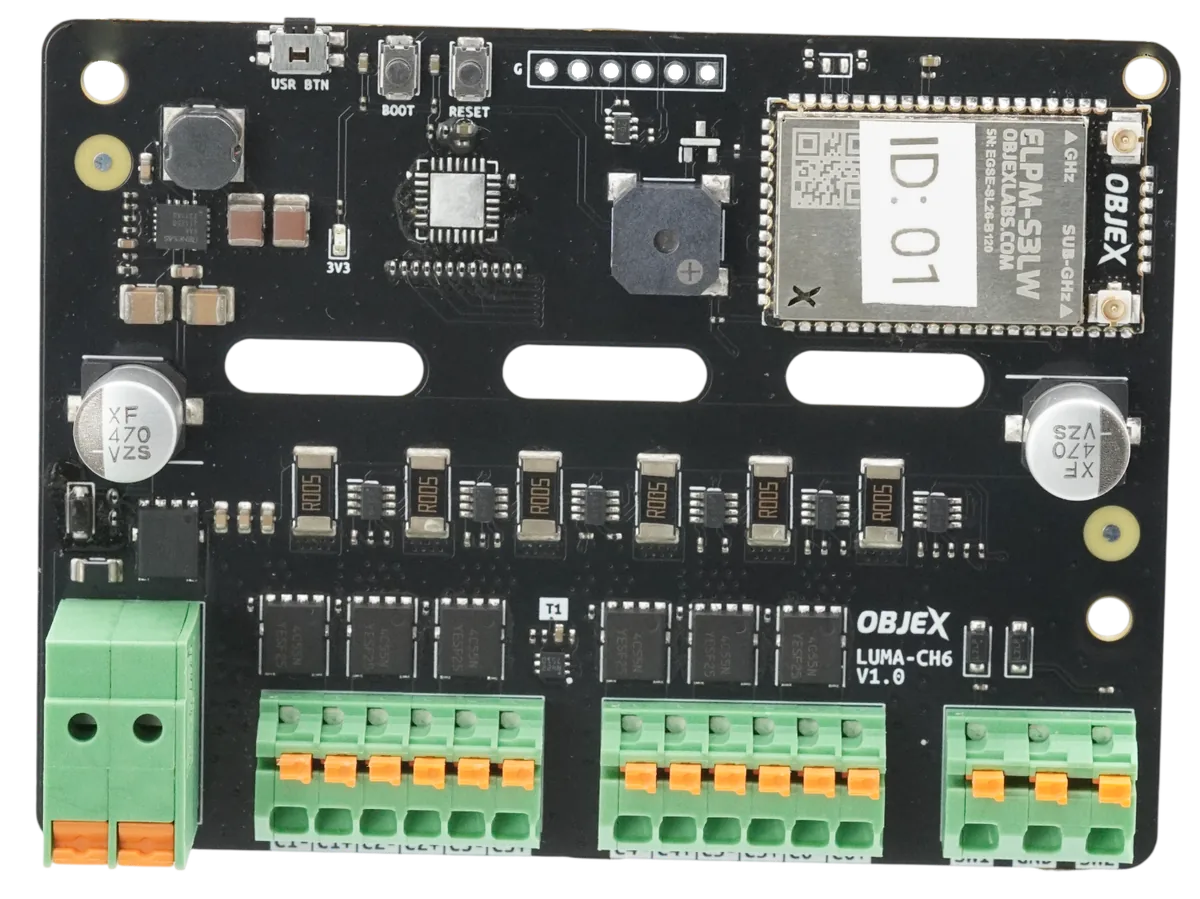
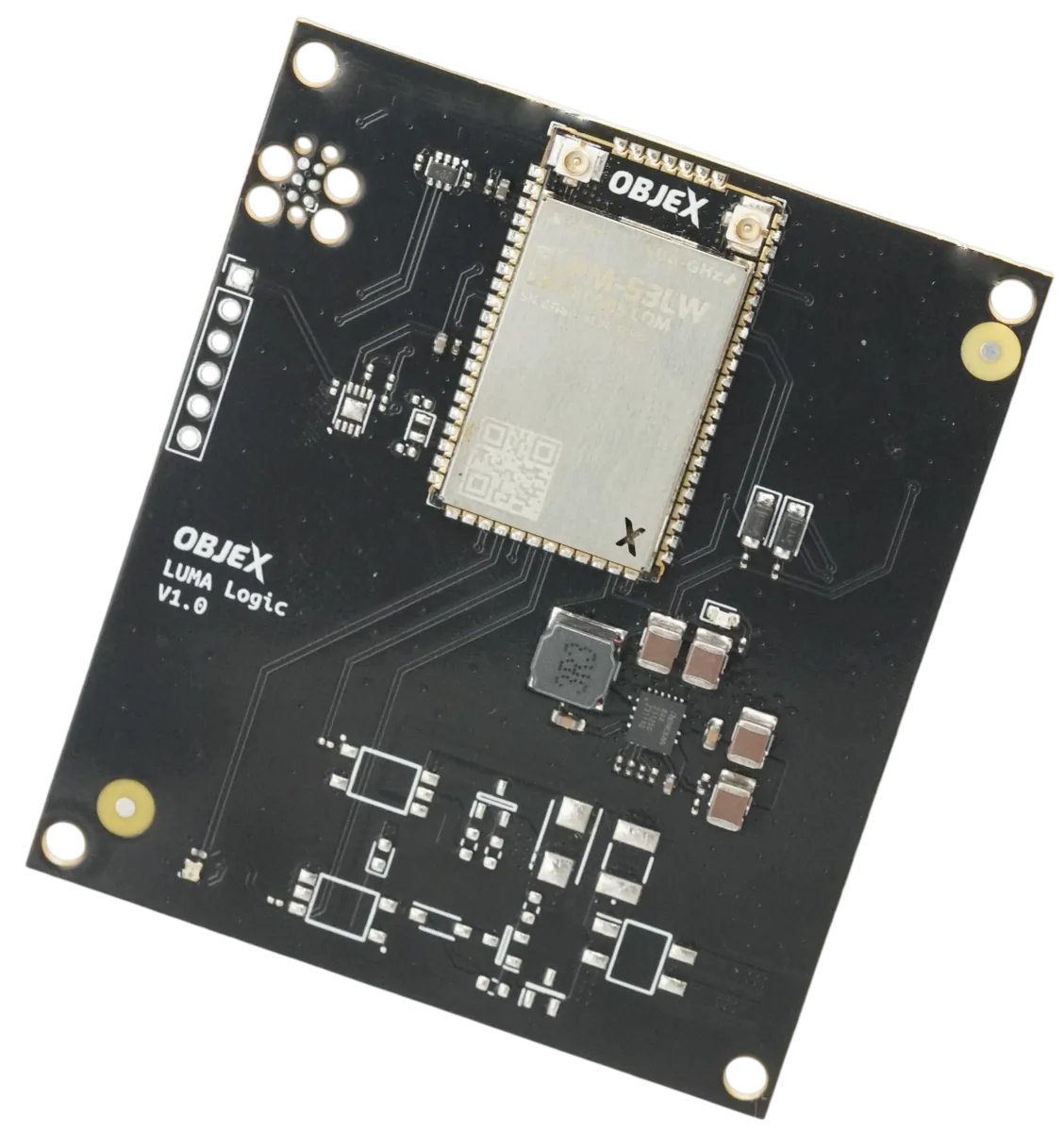
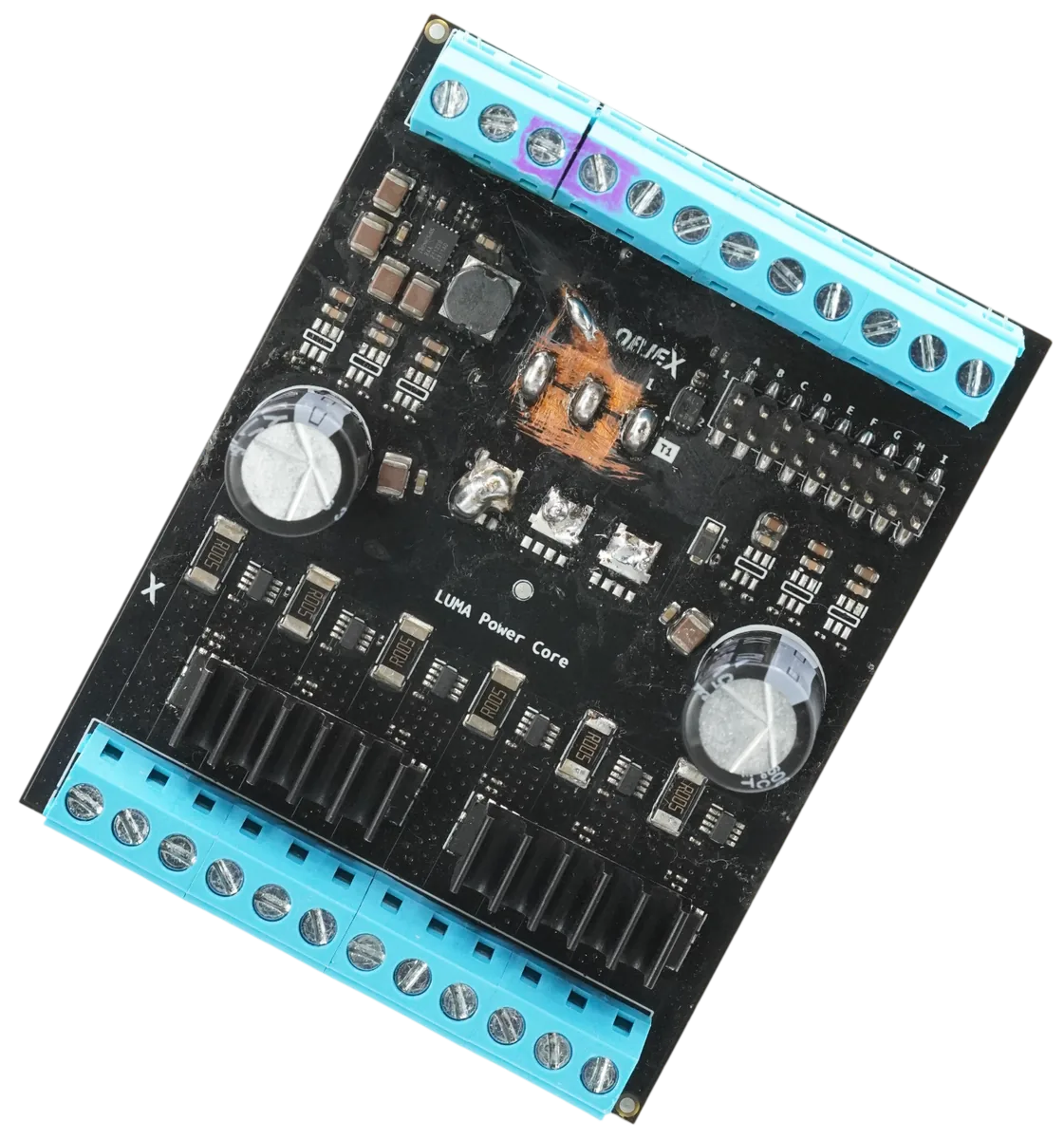
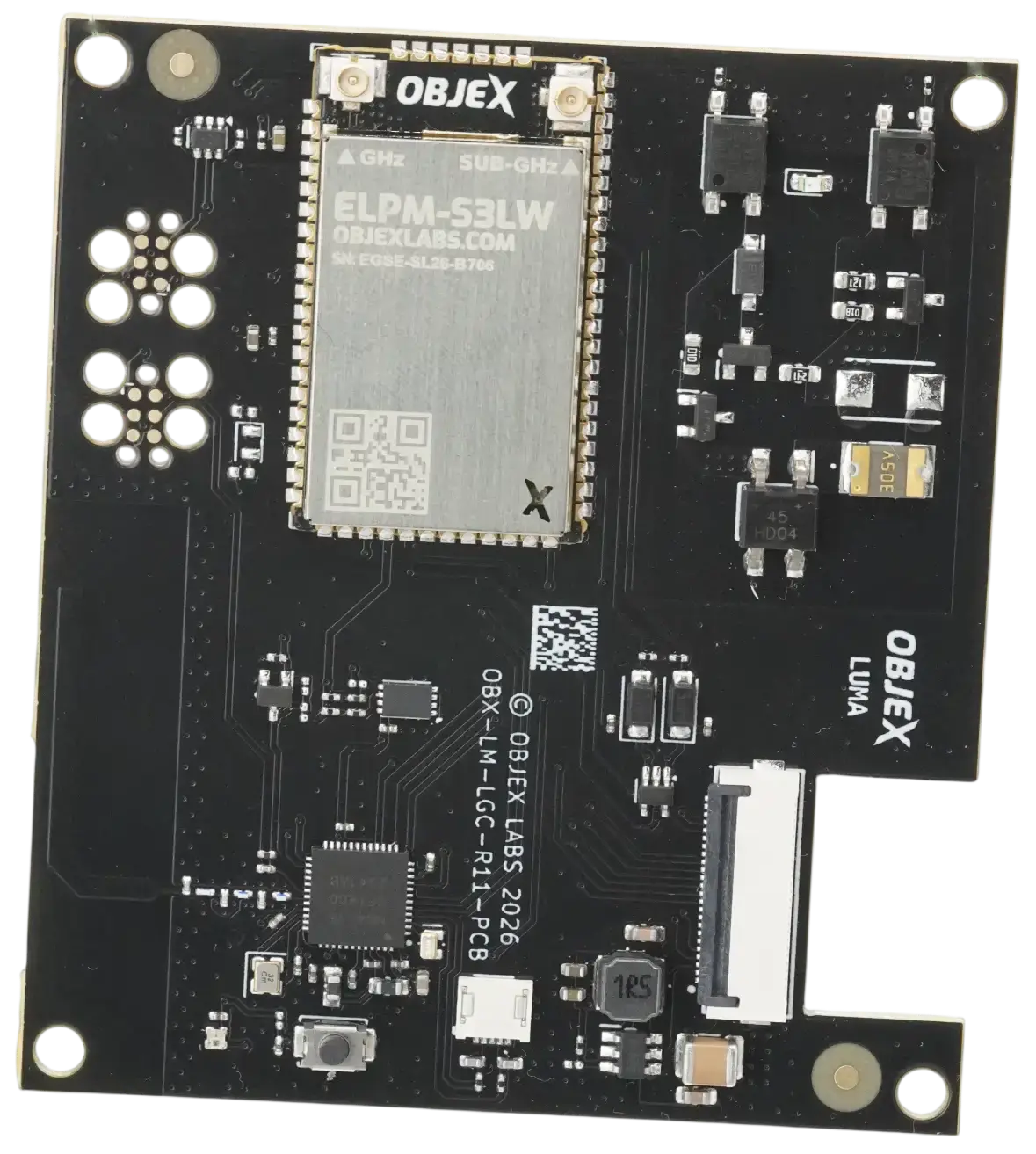
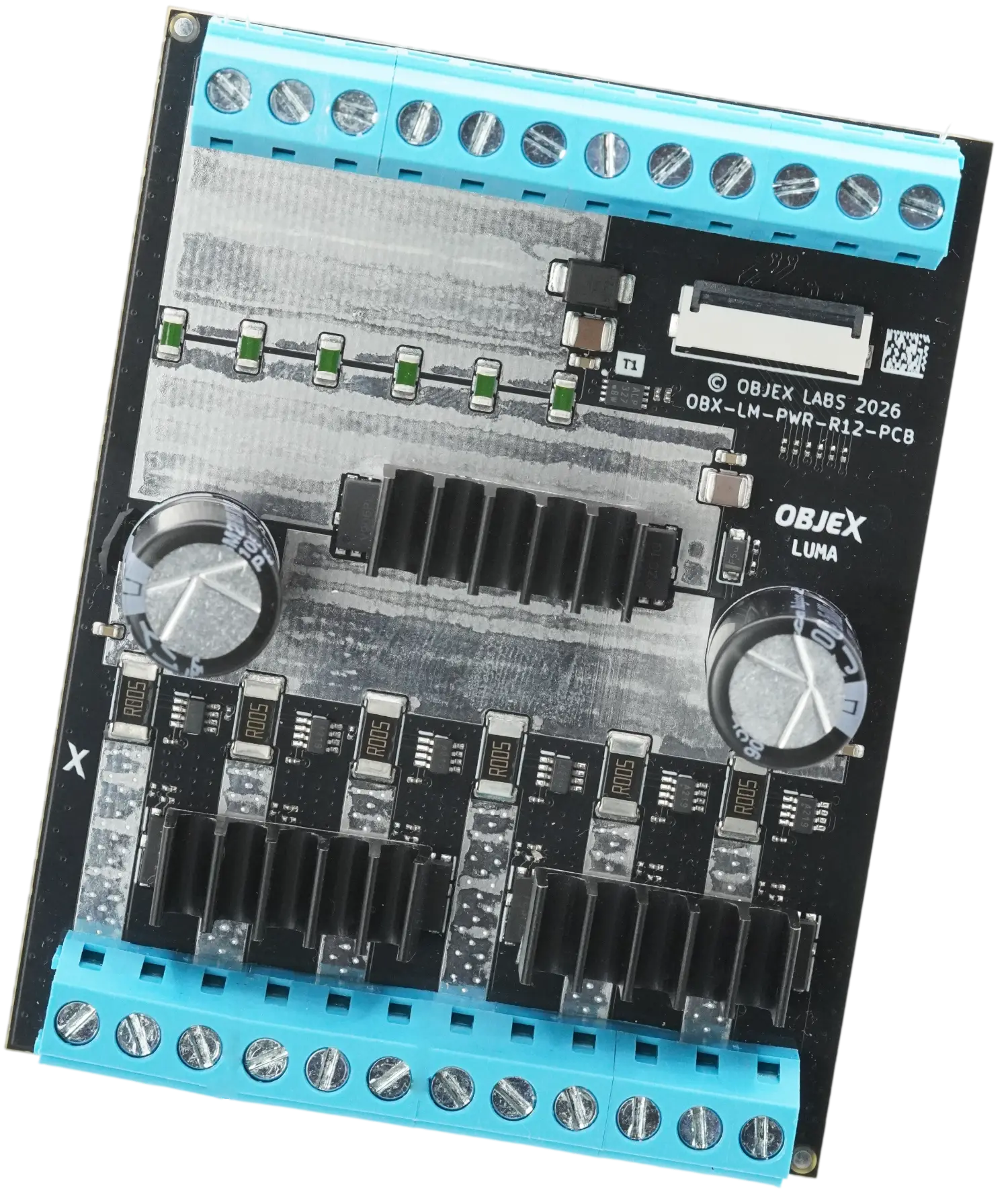
The first board validated the local-control concept. Later revisions separated logic and power, allowing control, radios, security, outputs and thermal behaviour to be developed and verified independently.
A real installation problem shaped the functions.
LUMA began with lighting inside the OBJEX LABS laboratory: some areas were too bright, others insufficient, and light needed to adapt to workbench activities. Early revisions explored timed and conditional sequences, routine-based automation, per-channel energy measurement, physical-control inputs and local integrations. These trials describe the development path; availability and status of each function must be checked on the current product page.
Evolution also includes installation format.
The first board was intended for a generic enclosure. The current mechanical direction is a four-module DIN-rail device with an alternative keyhole mount for a wall or service space. This choice connects PCB, terminals, wiring, heat flow and maintenance to the real installation context.
How to read these results.
These are development observations, not independent certifications. Full conditions, instruments and procedures will be consolidated in validation documentation. Always design an installation around the published rated limit: up to 180 W on an individual channel and 500 W combined, not the maximum reached during an overload test.
Review the product's features and current status.
LUMA-6CH