
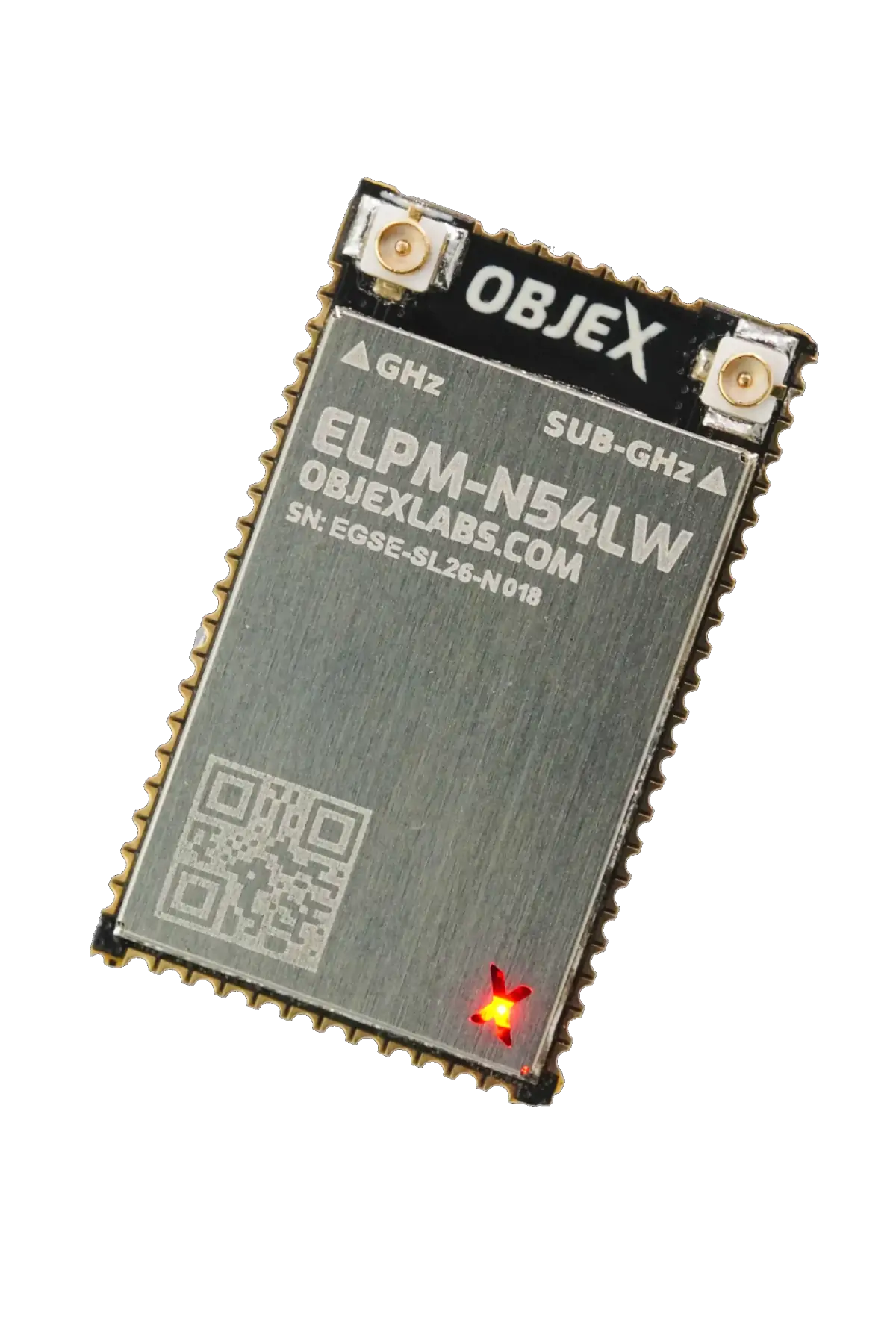
 ELPM-N54LW
Ultra-low-power dual radio for connected sensors
ELPM-N54LW
Ultra-low-power dual radio for connected sensors
CAD files
01 / Specifications
Two radios. Extremely low power. Sensors always ready.
ELPM-N54LW is an ultra-low-power dual-radio platform for sensors and IoT nodes, based on Nordic Semiconductor's nRF54L15. Bluetooth LE substantially reduces the energy required for local communication compared with a Wi-Fi architecture, while the SX1262 section extends coverage with LoRa and custom sub-GHz protocols.
System ON idle current can fall into the few-microamp range, depending on hardware and firmware configuration. The power latch also enables nanoamp-range Deep Stop. This makes N54LW suitable for battery-powered and low-duty-cycle sensors; energy harvesting is one of its specialties, not its only use case.
Core
| Main SoC | Nordic Semiconductor nRF54L15 |
|---|---|
| CPU | 128 MHz Arm Cortex-M33 + 128 MHz RISC-V coprocessor |
| Memory | 1524 KB NVM (RRAM) / 256 KB RAM |
| 2.4 GHz radio | Bluetooth LE, Mesh, Channel Sounding, IEEE 802.15.4, Thread, Zigbee, Matter / proprietary up to 4 Mbps |
| Low-power idle | Few µA possible in System ON depending on configuration; nRF54L15 reference: 0.8 µA |
| Bluetooth LE modes | LE 1M / LE 2M / LE Coded / Channel Sounding |
| BLE radio, SoC reference | 3.7 mA TX at 0 dBm; −96 dBm RX sensitivity at 1 Mbps |
| Toolchain | Nordic nRF Connect SDK / Zephyr RTOS / SWD |
| Interfaces | 62 castellated pins + A1/A2, GPIO, I²C, SWD, configurable UART and NFC antenna pins |
| Hardware security | ATECC608C + TrustZone, ECDSA/ECDH P-256, SHA-256 and AES-128 |
Sub-GHz
| Intended modes | LoRa / custom protocols |
|---|---|
| Transceiver | Semtech SX1262 revB |
| Frequency range | 862–928 MHz design target |
| RF output | −9 to +22 dBm; 118 mA typ. at +22 dBm |
| Receive | 4.6 mA typ. LoRa / 125 kHz; component reference |
| Antenna interface | 50 Ω U.FL; external antenna required |
| Application stack | Customer-firmware controlled |
Mechanical & certification
| Dimensions | 30 × 18 × 2.75 mm |
|---|---|
| Weight | Not specified |
| Certification | CE/RED, RoHS and REACH compliance for the ELPM-N54LW mass-production version. |
Reference design / KiCad
Four carrier boards to start an N54LW design.
The package includes direct supply, battery power latch, periodic RTC wake-up and an example sensor node. Its KiCad schematics, PCBs and libraries are editable for your application.
Explore the four circuits and the differences from S3LW →Power traces / Otii
The bench recordings behind these numbers.
- Deep stop, no RTCDownload unavailable for now
- Deep stop with RTCDownload unavailable for now
- LoRa TX/RXDownload unavailable for now
- Bluetooth LEDownload unavailable for now
Official Nordic references / nRF54L15
The SoC is designed to stay responsive at few-microamp current levels.
For the nRF54L15 SoC alone, under the conditions defined in its datasheet, Nordic specifies 0.8 µA typical in System ON idle with no retained RAM, 2.7 µA with 256 KB retained, and 2.9 µA with 256 KB, GRTC and LFXO. It specifies 3.7 mA typical for 2.4 GHz transmission at 0 dBm. These are SoC figures, not guaranteed measurements for the complete ELPM-N54LW: firmware, retained memory, clocks, secure element, RTC, SX1262 radio and carrier board all affect real consumption.
The nRF54L15 also integrates a 128 MHz Cortex-M33 and 128 MHz RISC-V coprocessor, 1524 KB RRAM, 256 KB RAM, an ADC up to 14 bits, Global RTC, EasyDMA serial interfaces, and hardware protections including TrustZone, secure boot, secure storage, tamper detection and side-channel protection.
Read the official Nordic datasheet →Energy calculator / Estimate
Turn a duty cycle into theoretical runtime.
Replace every assumption with measurements from your final device. The default Deep Stop value uses the 80 nA typical figure with RTC; processing and transmit currents and durations are adjustable application parameters.
Ideal mathematical estimate. It excludes harvested energy, battery self-discharge and ageing, temperature, regulator efficiency, startup peaks, external sensors, retransmissions, radio link quality and minimum voltage threshold. Always verify the complete prototype with a power measurement.
02 / Why ELPM-N54LW
Connect nearby. Reach farther. Keep control.
The module's value is not simply having two radios. It is being able to assign each radio the right job without locking the product into one protocol or service.
Bluetooth LE 6
Far more efficient local transmission than Wi-Fi for small payloads, sensors, commissioning and periodic communication.
1.8 V sub-GHz rail
VSUB powers the SX1262 directly from 1.8 to 3.7 V, ideal for low-voltage architectures; S3LW instead uses a dedicated 3.3 V LoRa rail. The N54LW main rail requires at least 2.0 V.
Deep Stop & RTC
Power latch, RV-3028-C7 RTC and wake inputs support intermittent nodes powered by batteries or energy harvesting.
Firmware under control
Application behaviour and radio strategy remain in the hands of the product team.
Few-µA idle
The node can remain responsive in System ON at few-microamp current levels, or use the power latch for Deep Stop.
Hardware root of trust
Unprovisioned ATECC608C for device identity, key protection, ECDSA/ECDH, SHA-256 and AES-128.
Typical applications
Where proximity and extended coverage must coexist.
Distributed sensors
Sensors in buildings, plants, land and infrastructure with more than one connectivity layer.
Compact edge gateways
Aggregate BLE devices and forward data or events through the sub-GHz link.
Long-range monitoring
Local and remote telemetry in the same node, using the protocol suited to the project.
Products with a dedicated protocol
Devices requiring control over message format, timing and radio behaviour.
FAQ
Questions, answered.
How can I request ELPM-N54LW?
Contact OBJEX LABS with your application, expected quantity, radio protocols and power requirements. The team can support module selection, integration and quotation.
Does the sub-GHz radio support only LoRa?
No. The SX1262 supports LoRa and (G)FSK modulation for custom protocols. LoRaWAN can be implemented in application firmware using an SX126x-compatible stack.
How should the Deep Stop figures be used?
The datasheet states 5 nA typical without RTC and 80 nA typical with RTC for the module. Complete-product consumption depends on sensors, protection, supply design, firmware and duty cycle.
How is it different from ELPM-S3LW?
The modules share the mechanical footprint and common interface numbering, but they are not direct electrical substitutes. N54LW prioritizes extremely low power, efficient BLE transmission, few-µA idle and sub-GHz connectivity; it is ideal for battery-powered and energy-harvesting sensors. S3LW provides ESP32-S3 and Wi-Fi when higher throughput or direct IP integration is needed.